Multiomics analysis
Go beyond a single layer of biology
RNA-seq tells us how gene expression changes. Proteomics tells us how protein abundance changes. But changes in RNA do not necessarily translate directly into changes in protein.
Integrating transcriptomics and proteomics can reveal biological responses that are difficult — or impossible — to identify from either dataset alone.
Rather than simply analysing two datasets separately, multiomics analysis connects them to ask:
Which changes are shared between RNA and protein?
Which are only detectable at one molecular level?
Where do RNA and protein change in opposite directions?
Are individual genes different, but the same biological pathways affected?
Which regulatory pathways or transcriptional programmes could explain the observed response?
Does an experimental treatment or genetic correction restore both molecular layers towards the control state?
From genes to biological response
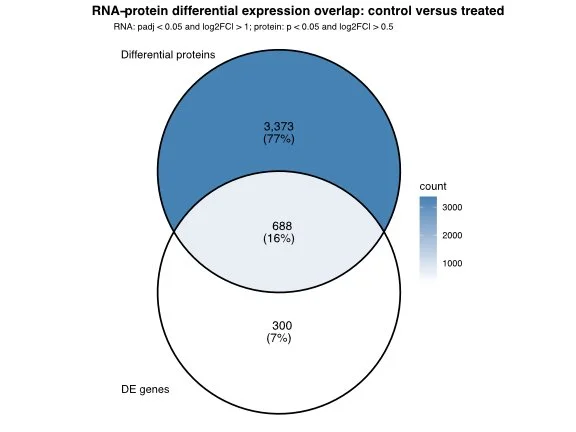
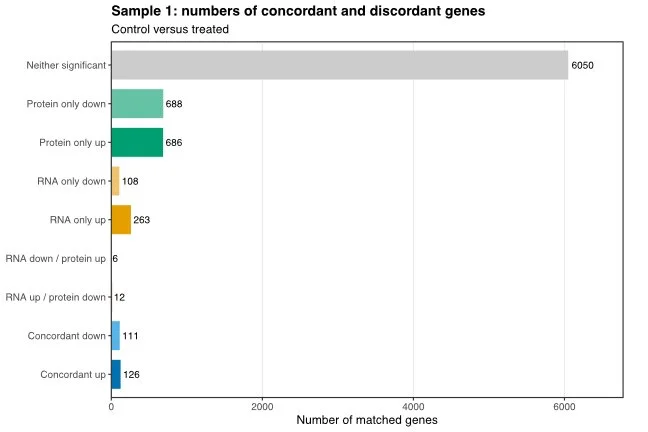
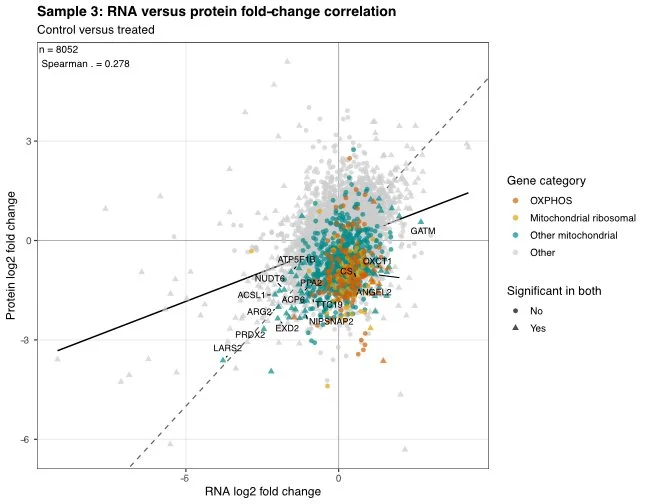
RNA and protein fold changes can be directly integrated to distinguish concordant and discordant responses.
Genes that change in the same direction provide evidence for a response propagated from transcript to protein. Just as importantly, genes that change only at the protein level, only at the RNA level, or in opposite directions can point towards post-transcriptional regulation, differences in protein stability, altered translation or other regulatory mechanisms.
Correlation analysis provides a global view of the relationship between the two molecular layers, while individual genes and functional groups can be investigated in more detail.
The same pathway can look very different at RNA and protein level
Integration becomes particularly powerful when moving beyond individual genes.
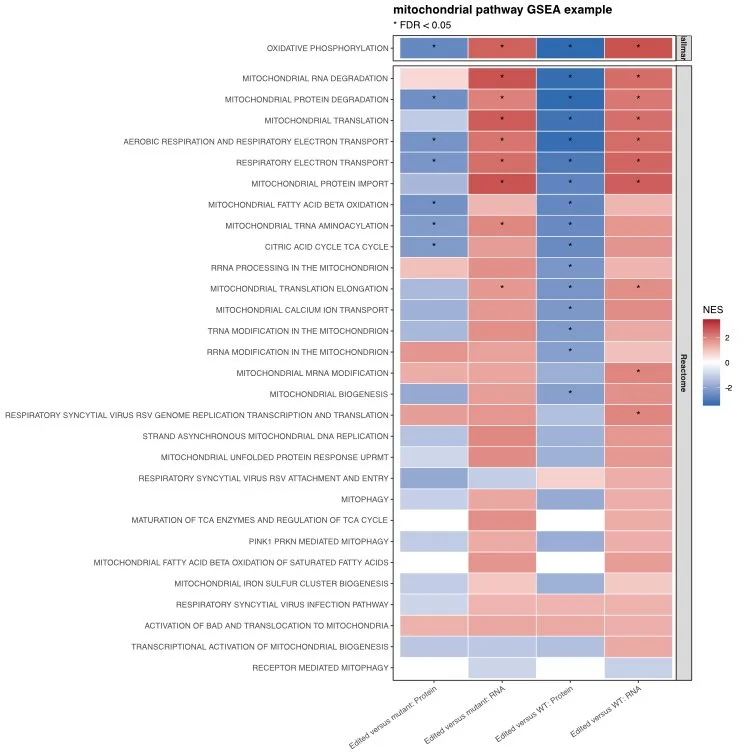
Pathway enrichment can be compared across RNA-seq and proteomics to determine whether the same biological processes are affected at both levels, even when the individual genes driving those signals differ.
It can also reveal cases where the two layers tell very different stories. In the example shown here, oxidative phosphorylation complexes display strong protein-level changes while the corresponding RNA response is much weaker and in the opposite direction. Looking at only one dataset would therefore give an incomplete picture of the underlying mitochondrial response.
From expression to pathway activity
Multiomics analysis can go beyond conventional enrichment analysis.
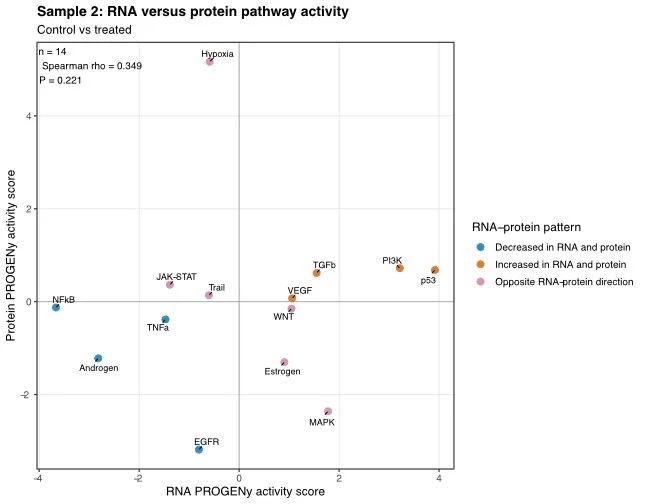
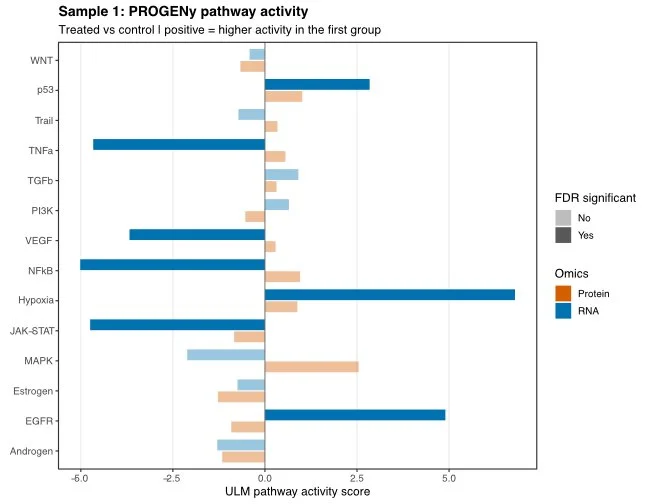
Methods such as PROGENy infer signalling pathway activity from downstream molecular changes, allowing pathway responses estimated from RNA and protein data to be compared directly.
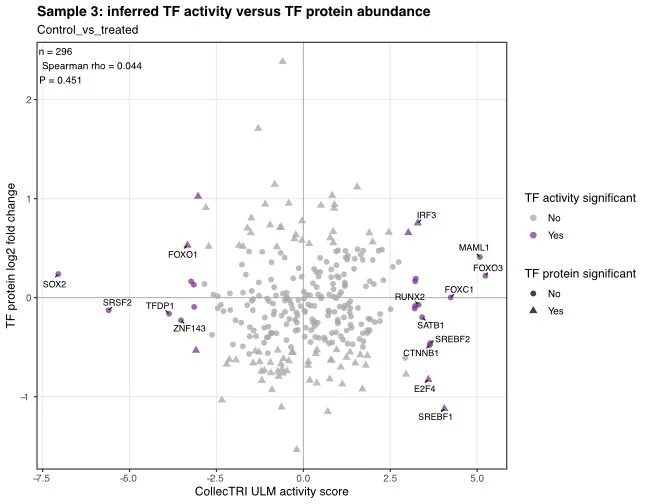
RNA-seq can additionally be used with regulatory-network approaches such as CollecTRI to infer transcription factor activity, helping move from which genes changed? towards what may be driving those changes?
Measuring biological rescue or treatment response
For intervention experiments, integration can answer an even more useful question:
Does the intervention actually move the molecular phenotype back towards the control state?
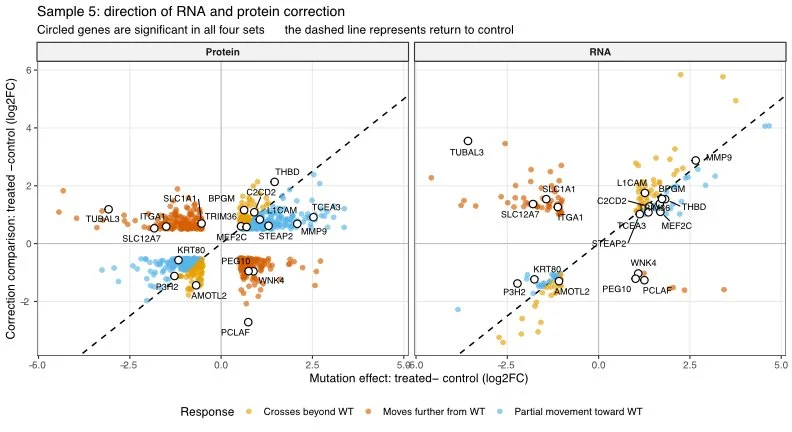
Instead of considering mutant-versus-control and treated-versus-mutant comparisons independently, directional analysis can follow the same genes through both contrasts.
Genes can then be classified according to whether treatment returns them towards the control state, partially corrects the change, overshoots the control state, produces a treatment-specific response, or moves them further away from control. These responses can be examined separately at the RNA and protein levels and across biological systems such as OXPHOS, mitochondrial translation, the TCA cycle and mitochondrial stress.
This can reveal whether an apparently successful molecular intervention produces a genuine biological rescue — and whether that rescue is visible at the transcript, protein, pathway or regulatory level.
More than the sum of two datasets
The strength of multiomics is therefore not simply having more data.
It is the ability to distinguish biological signals that agree across molecular layers from those specific to one layer and to use those relationships to generate biological insights that RNA-seq or proteomics alone may miss.
Multiomics analysis can be tailored to the biological question and can include RNA–protein integration, concordance and discordance analysis, pathway enrichment, signalling activity, transcription factor activity and directional treatment or rescue analysis.