
Bioinformatics, multiomics and AI for life science
Expert data analysis and scientific consultancy for academia and biotech.
Modern biological research generates increasingly complex datasets. The challenge is no longer simply producing data — it is determining what those data actually tell us about the biology.
Our mission is to help researchers use their data to answer the biological questions that matter to their research.
We work with academic and biotech researchers across genomics, transcriptomics, proteomics and other areas of life science. Every project is approached individually because the right analysis depends on the experimental design, the data and, most importantly, the scientific question.
Every project is approached strategically and independently, because no two datasets, experiments, or research questions are the same.
Why choose NextGenSeek:
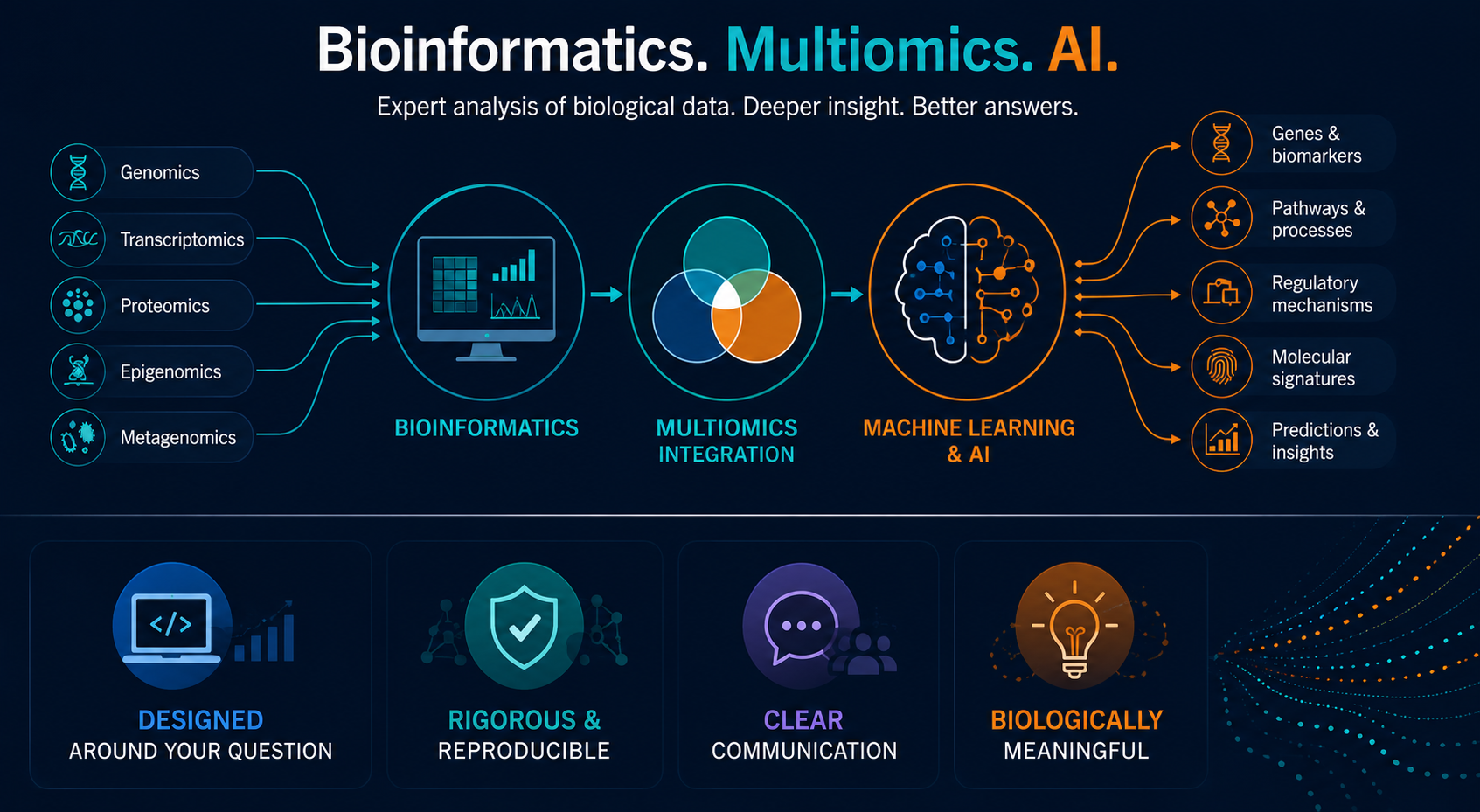
Scientific expertise, not black-box analysis
Bioinformatics software — and increasingly AI — makes it easy to generate an analysis.
Knowing whether that analysis is appropriate is much harder.
We combine computational analysis with biological expertise to assess whether results make sense in the context of the experiment, identify potential artefacts and determine which findings warrant further investigation.
Analysis designed around your experiment
We don't believe in one-size-fits-all pipelines.
The experimental design and biological question determine the analysis, not the other way around. This is particularly important for complex experimental designs, multiomics studies and projects where standard pipelines cannot adequately address the scientific question.
Rigorous and reproducible
Our analyses use established statistical and bioinformatics methods together with modern computational approaches.
Workflows are designed to be:
Transparent
Reproducible
Statistically appropriate
Biologically interpretable
Suitable for publication and further investigation
From data to biological interpretation
A significant result is not necessarily an important biological result.
We go beyond lists of differentially expressed genes or proteins to investigate pathways, regulatory mechanisms and relationships between datasets, helping you determine what your results mean for the underlying biology.
Explore our services:
Bioinformatics
Bioinformatics analysis designed around your experiment and research question, from processing raw data through to statistical analysis, visualisation and interpretation.
RNA-Seq · Single-cell RNA-Seq · Proteomics · Metagenomics · Epigenomics · DNA sequencing · Gene-editing analysis · Pathway analysis
Multiomics
Different types of data can tell different parts of the same biological story. We combine datasets such as RNA-seq and proteomics to examine where molecular changes agree, where they differ, and what those differences can tell us about the underlying biology.
Analysis can include RNA–protein integration, pathway-level comparison, concordant and discordant responses, regulatory networks, and treatment or disease-response analysis.
AI & Machine Learning
Machine learning provides additional ways to explore complex biological datasets, identify patterns and build predictive models.
We use supervised and unsupervised machine learning, together with model interpretation and explainable AI, to investigate biological data and understand which features are driving the results.
Scientific consultancy
Not sure which analysis you need, or still planning the experiment?
We provide advice on experimental design, sequencing strategy, statistical analysis, bioinformatics and data integration before or after data collection.
Scientific consultancy
Good analysis starts before the data are generated.
NextGenSeek provides consultancy for experimental design, sequencing strategies, bioinformatics planning and data-analysis approaches.
We can help with questions such as:
Which experimental design will answer my research question?
How many biological replicates are required?
What sequencing depth is appropriate?
Which data types would be most informative?
Would combining transcriptomics and proteomics add value?
Which statistical or machine-learning approach is appropriate?
How should complex datasets be integrated?
Early bioinformatics input can prevent costly experimental and analytical problems later.
Contact us for NGS consultancy or for Science consultancy.